The 10 Best B2B Marketing Campaigns and What Your Company Can Borrow
Most lists of the best B2B marketing campaigns tell you a campaign “went viral” or “drove massive growth” and stop there. That’s not much use if you have to explain to a CFO why your next campaign deserves budget.
So we set a rule for this list. A campaign only made the cut if the company, its agency, or an official awards entry published a result you can check. Each entry links to that source. Where the published record is thin, we say so. Mailchimp’s famous campaign made the list with that caveat attached.
These are business to business marketing examples from trucks, software, shipping, and semiconductors. For each campaign you’ll get the goal, what the team did, what was documented, and the move a company with a long, complex sale can borrow without a global media budget. At the end, we’ll show three campaigns we ran for smaller B2B companies and a plan you can use for your own.

The best B2B marketing campaigns at a glance
| # | Campaign | Year | Type | Documented result |
|---|---|---|---|---|
| 1 | Volvo Trucks, Live Test and “The Epic Split” | 2013 | Product demonstration | 100M+ YouTube views across the series. Almost half of truck buyers who saw it said they were more likely to choose Volvo. |
| 2 | Workday, “Rock Star” | 2023 | Buyer identity | 50% increase in marketing-qualified leads |
| 3 | Spotify Advertising, “Spreadbeats” | 2024 | Buying-moment activation | Nine Cannes Lions, including a Grand Prix |
| 4 | Gong, Gong Labs | 2016 onward | Original research | LinkedIn audience grew from 12,000 to 220,000+ followers |
| 5 | HubSpot, Website Grader | 2007 | Free diagnostic tool | 1M+ website and blog URLs graded |
| 6 | GE, “What’s the Matter With Owen?“ | 2015 | Brand repositioning | Job applications up eightfold |
| 7 | Maersk Line on social media | 2011–2013 | Social storytelling | 400,000 Facebook page likes in 11 months on a roughly $100,000 first-year budget |
| 8 | Mailchimp, “Did You Mean MailChimp?“ | 2017 | Brand awareness | Cyber Grand Prix, Cannes Lions 2017 |
| 9 | Salesforce, Trailhead | 2014 onward | Education and community | 5M badges and 22M+ challenges completed in about three years |
| 10 | Intel, “Intel Inside” | 1991 | Partner co-marketing | 500+ PC makers joined the co-op program by the end of 1992 |
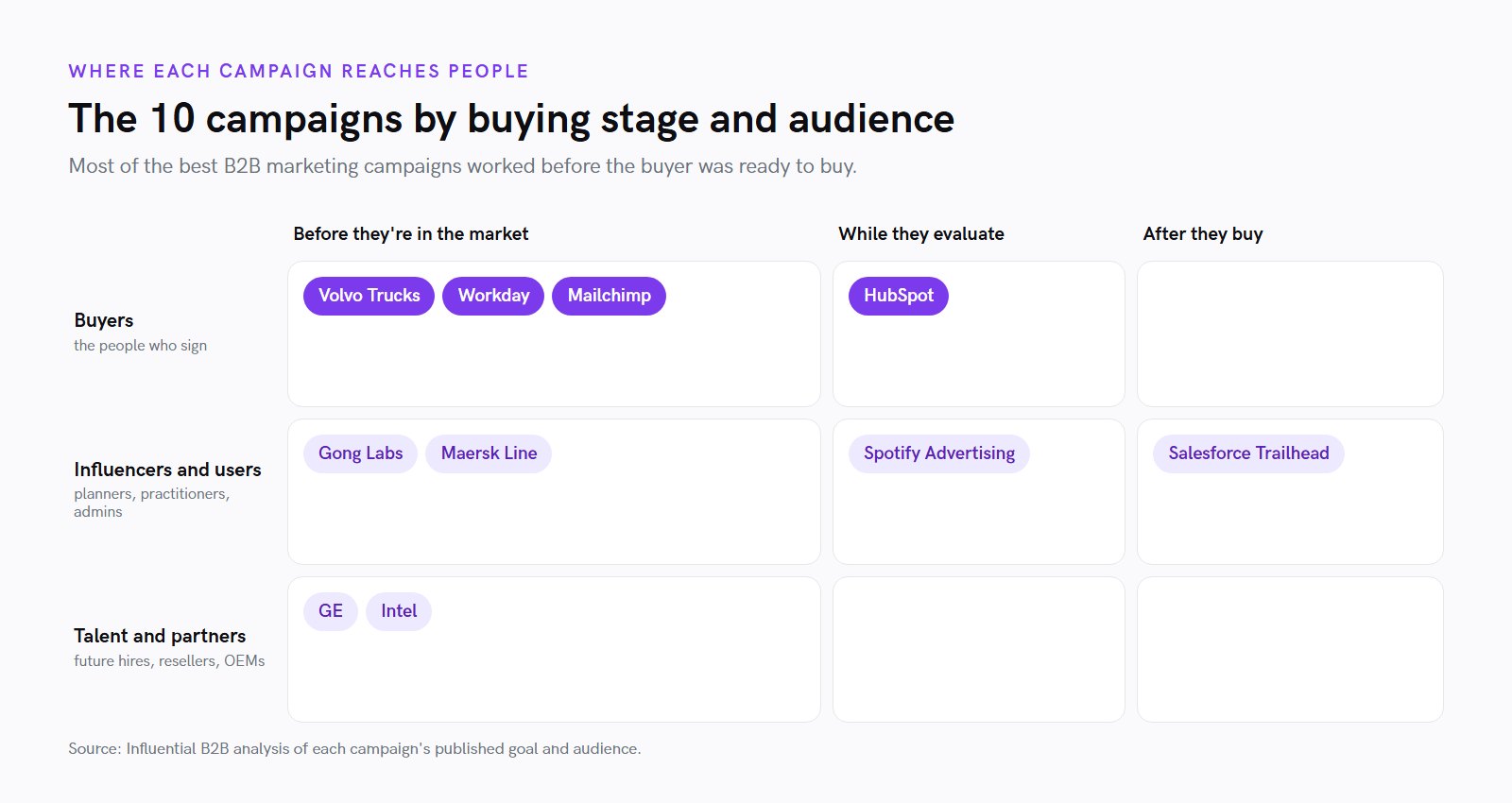
The chart sorts the campaigns by when they reach the buyer and who they reach. Notice that only some of them were aimed at the person who signs the contract. GE’s campaign reached engineers it wanted to hire. Salesforce trained the administrators who run its software. Intel reached PC buyers through the manufacturers it sold to.
What makes a B2B marketing campaign successful?
A B2B marketing campaign is a coordinated push around one goal, with a defined audience, message, set of assets, and time frame. It differs from a consumer campaign in one important way: a business purchase is usually approved by a group. A finance lead, a technical evaluator, an end user, and an executive sponsor might each need a different reason to say yes.
We judged every campaign on this list against five questions. The first three come from how most marketers evaluate campaigns. The last two matter most when the sale is long and the buyer is a committee.
| Criterion | The question to ask | Strong example |
|---|---|---|
| Creativity and innovation | Would the audience remember it a month later without being reminded? | Spotify coded a music video inside a media-plan spreadsheet. |
| Audience engagement | Did the right people spend time with it, share it, or act on it? | Gong’s research posts built a six-figure LinkedIn following among sales leaders. |
| Measurable results | Is there a documented result closer to revenue than reach? | Workday reported a 50% increase in marketing-qualified leads. |
| Fit with the buying group | Does it reach the people who influence the decision, as well as the person who signs? | Intel made PC buyers ask for the component their suppliers chose. |
| Reusability | Could a company with a fraction of the budget borrow the idea? | HubSpot’s free grader turned a diagnosis into a sales conversation. |
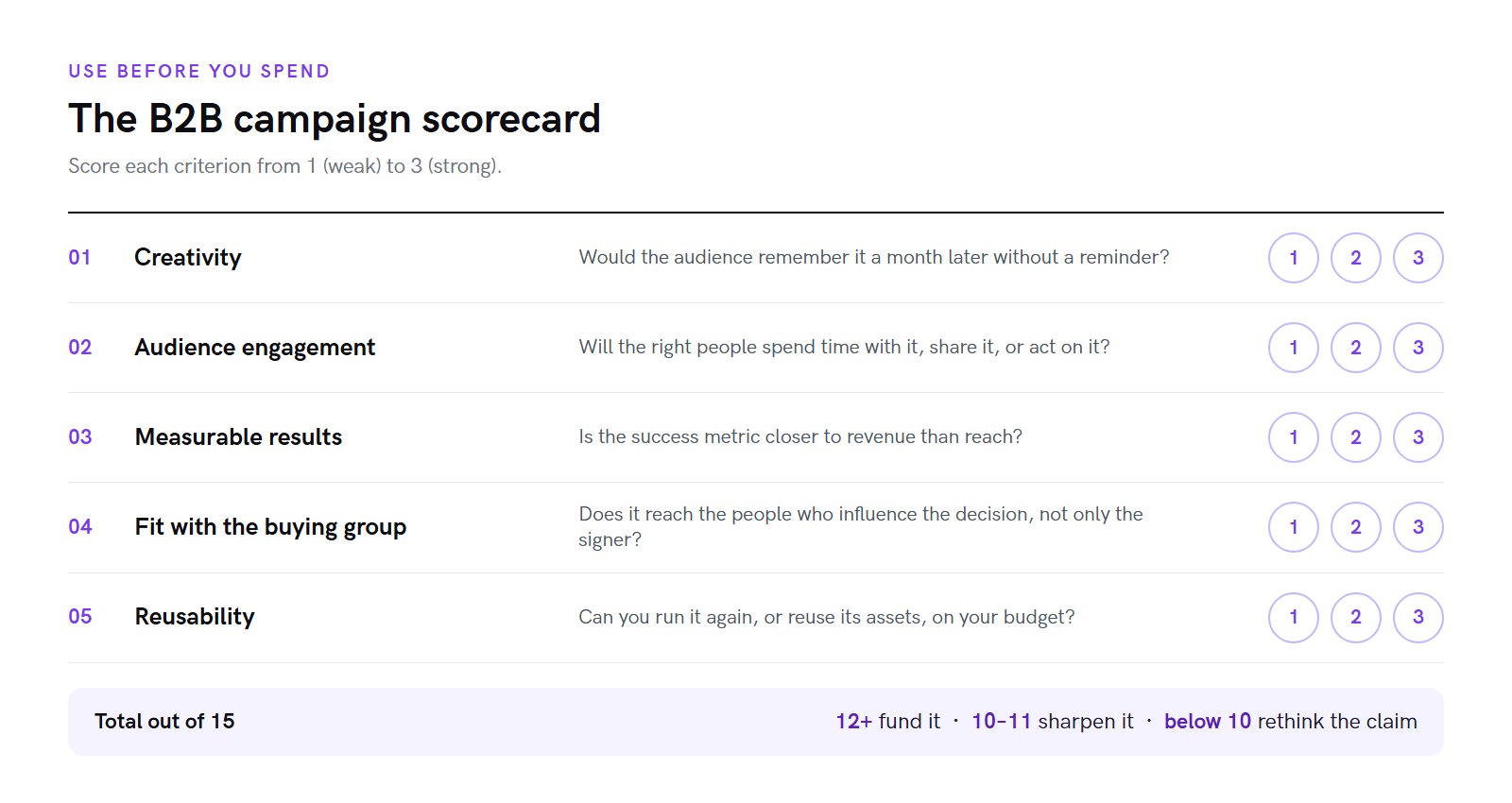
You can use the same scorecard on your own ideas before you spend money. Score each criterion from 1 to 3. Anything below 10 usually needs a sharper claim or a better way to measure it.
The 10 best B2B marketing campaigns
1. Volvo Trucks: the Live Test series and “The Epic Split” (2013)
The goal. Volvo Trucks wanted to demonstrate the innovations in its new truck range. Trucks are bought by fleet operators who compare specifications, and a press release about steering precision is easy to ignore.
What they did. Working with the agency Forsman & Bodenfors, Volvo released six short films that each tested one feature live. The most famous, “The Epic Split,” shows Jean-Claude Van Damme balancing between two reversing trucks to demonstrate the stability of Volvo Dynamic Steering. Volvo said the films were distributed only online.
The documented result. According to Volvo’s June 2014 release, the Live Test films passed 100 million YouTube views and were shared nearly 8 million times. “The Epic Split” alone passed 73 million views. Volvo counted more than 20,000 media reports and estimated the earned media value at €126 million. The result that matters most for a B2B team: almost half of the truck buyers who had seen the videos said they were more likely to choose Volvo for their next purchase. The campaign also won 20 Cannes Lions, including the Grand Prix in Cyber and Film. Volvo Trucks press release
What to borrow. Pick one claim your buyers doubt and prove it where they can watch. You don’t need a movie star. A consulting firm could record a working session that diagnoses a real (anonymized) problem in 20 minutes, or publish a before-and-after teardown of a client system. Proof that people can see beats adjectives in a proposal.
2. Workday: “Rock Star” (2023)
The goal. Workday was well established in HR software but wanted finance and IT leaders to take it seriously. The agency’s insight was that these leaders are often treated as “back-office” executives, while the corporate world hands out the “rock star” label to anyone.
What they did. Workday’s first Super Bowl ad, built with Ogilvy, featured Ozzy Osbourne, Joan Jett, Billy Idol, Paul Stanley, and Gary Clark Jr. telling the corporate world to stop calling everyone a rock star. The idea ran beyond the TV spot: vintage-style band posters on LinkedIn, print and outdoor ads, short-form video, and a kit of stickers, wallpapers, and merchandise for Workday’s 17,000 employees.
The documented result. Workday’s Cannes Creative Effectiveness entry, as summarized by WARC, reports a 50% increase in marketing-qualified leads, 4.35 billion earned impressions, and consideration of 63%. The campaign won a Bronze Lion for Creative Effectiveness. WARC case summary
What to borrow. B2B ads don’t have to be dull. Celebrate the buyer’s professional identity instead of your features. Then hand your own team the materials to carry the campaign. Your employees’ networks probably overlap with your buyers far more than your ad targeting does.
3. Spotify Advertising: “Spreadbeats” (2024)
The goal. Spotify Advertising sells ad space to brands, and those budgets are shaped by media planners who spend their days in spreadsheets. It needed planners to remember Spotify at the moment they build a plan.
What they did. Spotify and FCB New York created what they described as a first-of-its-kind music video made and distributed entirely inside a media-plan spreadsheet, set to a track by producer John Summit. The campaign entry says it went to 5,800 media planners in 14 countries.
The documented result. Spotify reported that the campaign won nine Cannes Lions in 2024, including a Grand Prix, two Golds, three Silvers, and three Bronzes, and that it was the most shortlisted submission of the festival. Spotify hasn’t published pipeline results we could verify, so treat this one as the standard for B2B creativity. Spotify newsroom · Cannes Lions entry
What to borrow. Meet buyers inside the tool they already work in, at the moment they make the decision. For a B2B company, that might be a template your buyers paste into their planning deck, a calculator built into a proposal, or a checklist formatted for the vendor review they’re about to run.
4. Gong: Gong Labs (2016 onward)
The goal. Gong sold revenue intelligence software into a crowded sales-technology market. It needed sales leaders to pay attention to a new company.
What they did. Gong Labs published original, data-backed research about different parts of the sales process. The content team opened each piece with a relatable sales scenario before getting to the data, and avoided promoting the product during the first year. LinkedIn was the main channel, backed by a blog, a podcast, webinars, and short video.
The documented result. In an account written for HubSpot’s blog, Devin Reed describes growing Gong’s LinkedIn page from 12,000 to more than 220,000 followers, a podcast that passed 100,000 downloads in 18 months, and webinar registrations that rose from 500 to over 2,500. The team tracked audience growth, direct traffic, and inbound deals rather than relying on last-touch attribution. HubSpot: How I applied the 95-5 rule to build Gong’s brand
What to borrow. Publish what only you can know. Most B2B companies sit on useful data: project timelines, the questions buyers ask in discovery, common failure points, pricing benchmarks. Anonymize it, add a point of view, and it becomes content that competitors can’t copy.
5. HubSpot: Website Grader (2007)
The goal. HubSpot was selling inbound marketing software to small businesses that didn’t yet know they had an inbound marketing problem.
What they did. It launched Website Grader in February 2007, a free tool that scored a website’s marketing and showed what to fix. HubSpot described it as a way to drive buzz, traffic, links, and leads, and as a useful tool in the sales process.
The documented result. By around 2009, HubSpot reported that Website Grader had graded more than 1 million website and blog URLs. It was later replaced by Marketing Grader in 2011. HubSpot blog: Website Grader evaluates over 1 million URLs
What to borrow. Build a free diagnostic that reveals the problem you solve. The buyer gets something useful right away, and your sales team gets a conversation starter based on the buyer’s own results. Assessments, audits, and benchmark calculators all work this way.
6. GE: “What’s the Matter With Owen?” (2015)
The goal. GE wanted to talk about being a “digital industrial” company. Most people still thought of it as the company that made appliances and light bulbs.
What they did. BBDO New York created a series of spots about Owen, a young developer who has just taken a job at GE. His friends and family can’t understand why he’d work there instead of at a trendy app company. In one spot, his father hands him the family hammer, and Owen tries to explain that he’ll be writing code.
The documented result. GE’s chief marketing officer, Linda Boff, told Contently that the campaign increased applications to work at GE eightfold. She added that it hadn’t started as a recruiting campaign at all. Contently interview with Linda Boff
What to borrow. A B2B campaign reaches more than buyers. Engineers, partners, and future employees are watching too, and they often influence the sale. If your market still sees you as what you used to be, show the new version through the eyes of someone who chose it.
7. Maersk Line: building a social following for container shipping (2011–2013)
The goal. Maersk Line moves containers between ports, which hardly seems like a topic for Facebook. In late 2011, it put Jonathan Wichmann in charge of finding out whether social media could help anyway.
What they did. The team shared the stories that were already there: ships, crews, ports, and more than a century of company history.

The documented result. A 2015 California Management Review analysis reports that Maersk reached 400,000 Facebook page likes within 11 months on a first-year budget of about $100,000. The program won European Digital Communications Awards in 2012 and 2013. The same analysis notes that when Maersk Drilling recruited 3,000 people in 2013, applications rose 600 percent over earlier drives. It’s careful to say that Maersk’s later stock gains can’t be attributed to social media. California Management Review: Maersk, the value of social media
What to borrow. No industry is too technical for good stories. Your engineers on site, the hardest problem you solved this quarter, and the history of your craft can all become content that people choose to follow.
8. Mailchimp: “Did You Mean MailChimp?” (2017)
The goal. People constantly misheard and mispronounced Mailchimp’s name. The company wanted to raise awareness among small business owners and creative professionals.
What they did. With Droga5, Mailchimp turned the problem into the campaign. It created a series of fictional brands with names that sound like Mailchimp, such as FailChips, KaleLimp, JailBlimp, and SnailPrimp. Each odd name was built to send curious searchers back to the real one.
The documented result. The campaign won the Cyber Grand Prix at Cannes Lions 2017, one of three Grand Prix the Cyber jury awarded that year. LBB: Cannes Lions 2017 Cyber winners Reach and search figures circulate online, but we couldn’t trace them to Mailchimp or Droga5. Treat this campaign as a standard for creativity rather than evidence that it drove pipeline.
What to borrow. Turn something your market already says about you into the hook. If buyers think you’re too small, too expensive, or too specialized, a campaign that owns the objection tends to be remembered.
9. Salesforce: Trailhead (2014 onward)
The goal. Salesforce’s growth depended on people who could administer, build on, and recommend its platform. There weren’t enough of them.
What they did. Trailhead is a free, gamified learning platform where people earn badges for completing hands-on challenges. Learners became part of a community Salesforce calls Trailblazers.

The documented result. In February 2018, Salesforce reported that Trailblazers had earned 5 million badges and completed more than 22 million challenges in about three years. The badge count had more than quadrupled in just over a year. Salesforce newsroom
What to borrow. Teach the people who will use and recommend you. For a services company, that could be a short certification for your clients’ teams, a workshop series, or an onboarding course that makes your client’s staff better at their jobs. People who learned their craft with you tend to bring you into the next project.
10. Intel: “Intel Inside” (1991)
The goal. Buyers never see a processor. Intel wanted PC buyers to care which chip was inside the machine they bought.
What they did. Intel trademarked “Intel Inside” and created a cooperative marketing program. It subsidized PC manufacturers that included the logo on their products and ads, starting with a $250 million initial investment.

The documented result. According to Intel’s history archive, more than 500 PC manufacturers had joined the cooperative program by the end of 1992, and 70 percent of manufacturer ads that could carry the logo did. Advertising Age later called it “the most effective co-op advertising program in history.” Intel: Ingredient branding
What to borrow. Make your partners’ marketing carry your name. If you sell through integrators, resellers, or other firms, give them co-branded assets, joint case studies, or a referral program that makes it easy to recommend you.
B2B marketing campaigns at a smaller scale
The campaigns above had global budgets. Most B2B companies don’t. Here are three B2B marketing examples from our own client work. They show the same ideas working with a small team and a niche market. The full write-ups are on our case studies page.

| Client | The move we borrowed | What we did | Published result |
|---|---|---|---|
| Xlera Solutions, FPGA consulting | Publish what only you can know (Gong) | Repositioned the firm from “We do FPGA projects” to “We commercialize FPGA products,” fixed attribution, and released an eBook written for teams moving from prototype to production | 287 qualified, opted-in contacts built from zero, plus 48 eBook opt-ins from a single cohort |
| AuthenTech AI, healthcare AI consulting | Build a free diagnostic (HubSpot) | Positioned around shadow AI risk and built an assessment that gives buyers a brief they can share internally | Assessment funnel launched around 1,600+ monthly shadow AI risk searches |
| MotorCoach.ai, transportation SaaS | Meet buyers at the buying moment (Spotify) | Replaced broad-match ads with competitor-keyword campaigns, comparison pages, and a pre-qualification step | 318K+ monthly visitors on competitor sites identified and targeted |
None of these needed a celebrity or a Super Bowl spot. Each needed a sharp claim, a reason for the right buyer to engage, and tracking that showed what happened next. That’s the work our demand generation service is built around.
Key takeaways from the best B2B marketing campaigns
What can we learn?
Put these B2B marketing examples side by side and seven patterns stand out. Most of the successful B2B marketing campaigns combine at least two.
- Prove one claim in public. Volvo didn’t list features. It staged a test that viewers could judge for themselves.
- Respect the buyer’s identity. Workday celebrated finance and IT leaders instead of explaining its software to them.
- Meet buyers inside their work. Spotify reached planners in a spreadsheet. HubSpot handed marketers a grade for their own website.
- Publish what only you know. Gong turned data from its own platform into research its buyers wanted to read.
- Build an audience that outlasts the campaign. Gong Labs, Maersk’s channels, and Trailhead kept paying off for years.
- Recruit allies to carry the message. Intel’s manufacturers and Workday’s 17,000 employees made each campaign bigger than its media budget.
- Measure something closer to revenue than reach. The strongest entries reported purchase intent, qualified leads, or applications, not just views.
The last point is where many B2B ads and campaigns fall down. Views and impressions are easy to report and hard to connect to a signed contract. Decide which number will show whether your campaign is working before you launch it.
How to plan a B2B campaign for a complex sale

- Pick one buying moment. Choose the situation you want to reach: a new regulation, a failed vendor, a budget cycle, or a leadership change.
- Write the one claim. State what you want the buying group to believe, in their words. If you can’t say it in a sentence, the campaign won’t either.
- Choose the proof. Decide how you’ll show the claim: a live demonstration, original data, a free diagnostic, a client story, or a partner’s endorsement.
- Map the buying group. List who influences the decision and what each person needs. Plan at least one asset for the evaluator and one for the budget holder.
- Set the decision rule. Agree on what result at 30, 60, and 90 days will mean continue, adjust, or stop. Tag every new contact and opportunity with its source.
- Run it longer than feels comfortable. Most complex sales take months. A campaign judged after two weeks gets judged on noise.
Our B2B marketing strategy framework includes a one-page template that turns a revenue goal into the number of qualified conversations a campaign needs to create.
Future trends in B2B marketing campaigns
A few shifts are changing how B2B campaigns get built.

- Most buyers aren’t in the market today. LinkedIn’s B2B Institute popularized the 95-5 rule: at any given moment, 95% of your potential buyers aren’t ready to buy. Campaigns that build memory, as Gong’s and Maersk’s did, prepare you for when buyers enter the market. LinkedIn: The 95-5 rule
- AI answers are a new place to be found. Google’s AI Overviews and AI Mode summarize topics and link to the sources behind them. Original research and clearly sourced examples give those systems something to cite. Google Search Central: AI features Our B2B SEO guide covers how to plan for that.
- Employees and creators are channels. Workday armed its staff. Expect more campaigns to plan for employee, partner, and practitioner voices from the start.
- Interactive tools are replacing gated PDFs. Assessments and calculators give the buyer an answer about their own situation, which is more useful than another eBook.
- Measurement is moving to the account. As buying groups grow, counting leads one at a time hides what’s happening. Teams increasingly ask whether the right accounts engaged and moved forward.
Frequently asked questions
What is a B2B marketing campaign?
A B2B marketing campaign is a coordinated set of messages, assets, and channels aimed at businesses rather than consumers, built around one goal and run for a defined period. The goal might be awareness with a buying group, a set of qualified sales conversations, or adoption by the people who use a product. Most B2B campaigns have to reach several people at the same company, because purchases are usually approved by a group.
What makes a B2B marketing campaign successful?
A successful B2B marketing campaign makes one clear claim that the buyer cares about, proves it in a way they can see, reaches the people who influence the decision as well as the person who signs, and is measured against something closer to revenue than reach. The best examples, such as Volvo Trucks’ Live Test series and Workday’s “Rock Star” campaign, reported results tied to buyers: purchase intent and marketing-qualified leads.
How long should a B2B marketing campaign run?
Run a B2B campaign at least as long as a typical sales cycle, so you can see whether early engagement turns into pipeline. For most companies with a complex sale, a 90-day pilot with review points at 30 and 60 days is a practical start. Brand programs such as Gong Labs or Salesforce Trailhead ran for years, and their results compounded over that time.
How do you measure the results of a B2B campaign?
Decide before launch which number will tell you to continue, adjust, or stop. Track reach and engagement, but report the campaign on qualified conversations, pipeline created, win rate, and deal size for the accounts it touched. Tag every new contact and opportunity with its source so you can connect the campaign to revenue later.
Can a small B2B company run campaigns like these?
Yes, if it borrows the idea rather than the budget. A five-person firm cannot buy a Super Bowl spot, but it can prove one claim on camera, publish data from its own projects, build a free assessment, or equip its partners to recommend it. Several of the campaigns on this list, including Maersk Line’s social program and HubSpot’s Website Grader, started small.
Final thoughts on B2B marketing campaigns
The best B2B marketing campaigns aren’t remembered for their budgets. They’re remembered because each one picked a single idea and proved it to the people who mattered: a split between two trucks, a grade for your website, a music video in a spreadsheet.
Start with the scorecard. Pick the one buying moment you most want to own, write the claim, and choose how you’ll prove it. If you’d like a second set of eyes on the plan, book a call with us. We’ll help you pressure-test the idea before you spend a dollar on media.
Ready to build the system?
Your expertise is the product.
Your go-to-market is the multiplier.
If this resonated, let's talk about what B2B marketing built around your buyers could look like for your company.
Get in touch →